
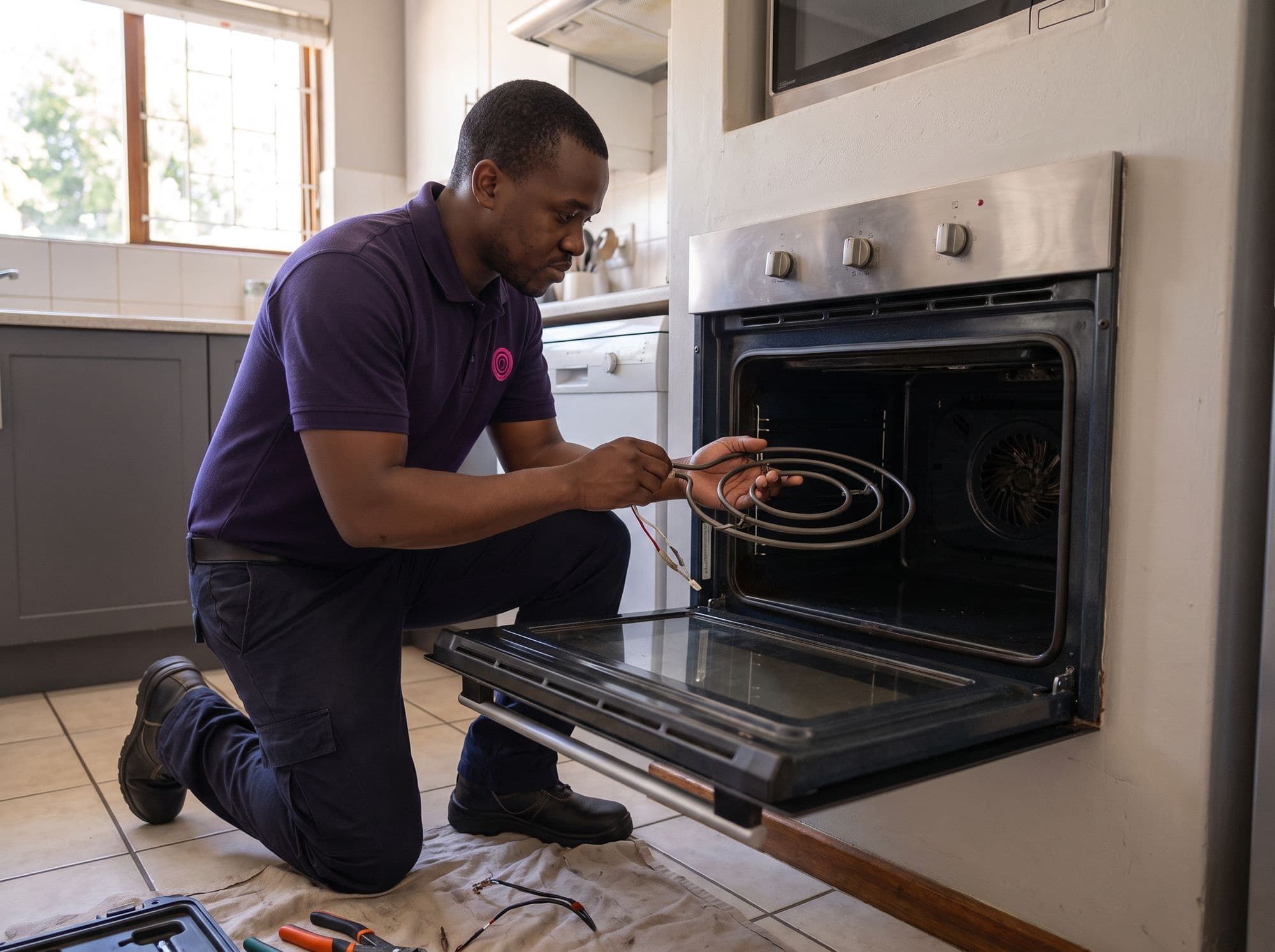
An oven that won't heat usually lets you know at the worst moment, with guests on the way or the Sunday roast half done. We repair electric ovens at homes across Johannesburg: built-in wall ovens, under-counter ovens, and the oven in a freestanding stove. The technician tests it in place, finds the fault, and tells you what the repair involves and what it will cost before any work starts.
Ovens are good candidates for repair. The parts that fail, such as elements, thermostats, fan motors, selector switches and door seals, are replaceable, and a built-in oven that fits your kitchen exactly is worth keeping. For plates and hobs, see stove repairs.
Common oven faults we fix
Not heating
A failed element is a common cause, as are the thermostat and the selector switch. If only some functions heat, such as grill but not bake, a single element has probably gone. Our oven not heating guide has safe checks first.
Fan not turning
A fan that won't spin, or grinds as it turns, usually needs a new fan motor. Without it, a fan oven heats unevenly or cuts out.
Uneven baking
Burnt on one side and pale on the other can mean a failed fan element, a weak fan, or a door seal that lets heat escape.
Running too hot or too cold
If recipes no longer work at the usual temperature, the thermostat or temperature sensor is probably reading wrong. It can be tested and replaced.
Door seal worn or door won't close
A hardened or torn seal, or a bent hinge, lets heat out and makes the outside of the oven hot. Both can be replaced.
Trips the electricity
An oven that trips the earth leakage when it heats usually has an element breaking down. Leave it off until it has been checked.
Is it worth it to repair an oven?
Usually, yes. Elements, thermostats, fan motors and seals cost much less than a new oven, and a built-in oven saves you the trouble of finding a model that fits the same cabinet opening. Replacing starts to make sense when an old oven needs a control board or several parts at once. Try the repair or replace check for a quick answer.
Can an electrician fix my oven?
An electrician deals with the supply: the wiring to the oven, the isolator and your distribution board. Faults inside the oven, such as elements, thermostats, fans, switches and seals, are an appliance technician's work. The technician checks the supply at the oven while finding the fault, and tells you if anything needs an electrician.
Can I fix my oven myself?
A few checks are safe and worth doing first:
- Make sure the clock is set. Some ovens with a timer won't heat until the time is set or the oven is put back into manual mode.
- Check that the isolator is on and the breaker hasn't tripped.
- Try each function: if the grill works but bake doesn't, tell the technician. It narrows the fault down.
Changing an element or a thermostat means working on parts that carry mains power, behind panels that hold heat. That part is best left to a technician.
Getting the best from your oven
A little care keeps the parts that fail most in good shape for longer:
- Keep oven cleaner off the door seal and the fan cover. It hardens the rubber and attacks the fan.
- Wipe up spills once the oven is cool, before they bake on around the element.
- Close the door gently. Slamming it bends the hinges and loosens the seal.
- If the oven has a pyrolytic or self-clean mode, empty it of trays and racks unless the manual says otherwise.

No call-out fee when we repair it.If no repair is done, a R500 call-out applies. The technician finds the fault and explains the repair before any work starts, so you decide whether to go ahead.
Book a repairOven repair questions
Why is my oven not heating up when the fan is working?
If the fan turns but the oven stays cold, the element behind the fan has usually failed, or the thermostat or a safety cut-out isn't letting power through. On an oven with a clock, check it isn't flashing after a power cut. Our guide to an oven not heating has safe checks to try first.
Why did my oven suddenly stop working?
Check the supply first: the isolator, the DB board and, on many ovens, a clock that needs setting after a power cut. If the oven is completely dead, a tripped thermal cut-out, a failed switch or a wiring fault is likely. If it trips the power as well, leave it switched off. Our guide to an oven not heating has the next checks.
Why does my oven trip the electricity when I switch it on?
Usually an element has a fault to earth: it may be split, blistered or damp after the oven stood unused. A wiring fault at the back can do the same. Switch the oven off at the isolator and don't keep resetting the power. Note which setting trips it, because that tells the technician which element to test. Book a technician.
Why is my oven temperature wrong?
Usually a thermostat or temperature sensor that reads wrong, a door seal letting heat out, or an element that has weakened. An oven thermometer on the middle shelf shows how far out it is. If it's a long way off, or the oven runs far too hot, it needs a technician: book a technician.
Is it worth replacing an oven element?
Almost always. An element is one of the most common oven repairs and costs far less than a new oven, especially a built-in one that has to fit your cabinet. The technician checks the thermostat and the wiring at the same time, so the new element isn't let down by another fault. See how our prices work.
Is it cheaper to repair or replace an oven?
In most cases repairing is cheaper. The common oven faults come down to an element, a thermostat, a fan motor or a switch, and those cost much less than a new oven plus installation. A control board on an old oven is the case to compare carefully. Our repair or replace check gives you a quick answer.
How do I reset my oven after a power cut?
If the clock is flashing, set the time or press the manual button (often a hand symbol): many ovens won't heat until you do. If there's no display at all, check the isolator and the DB board, then switch the oven off at the isolator for a few minutes and on again. Still cold? Book a technician.
Can I still use my oven if the fan is broken?
Not on a fan setting: without the fan, heat collects around the element, food cooks unevenly and the oven can trip its safety cut-out. Settings that don't use the fan may still work for now. A noisy or stopped fan motor is a common repair: book a technician.