
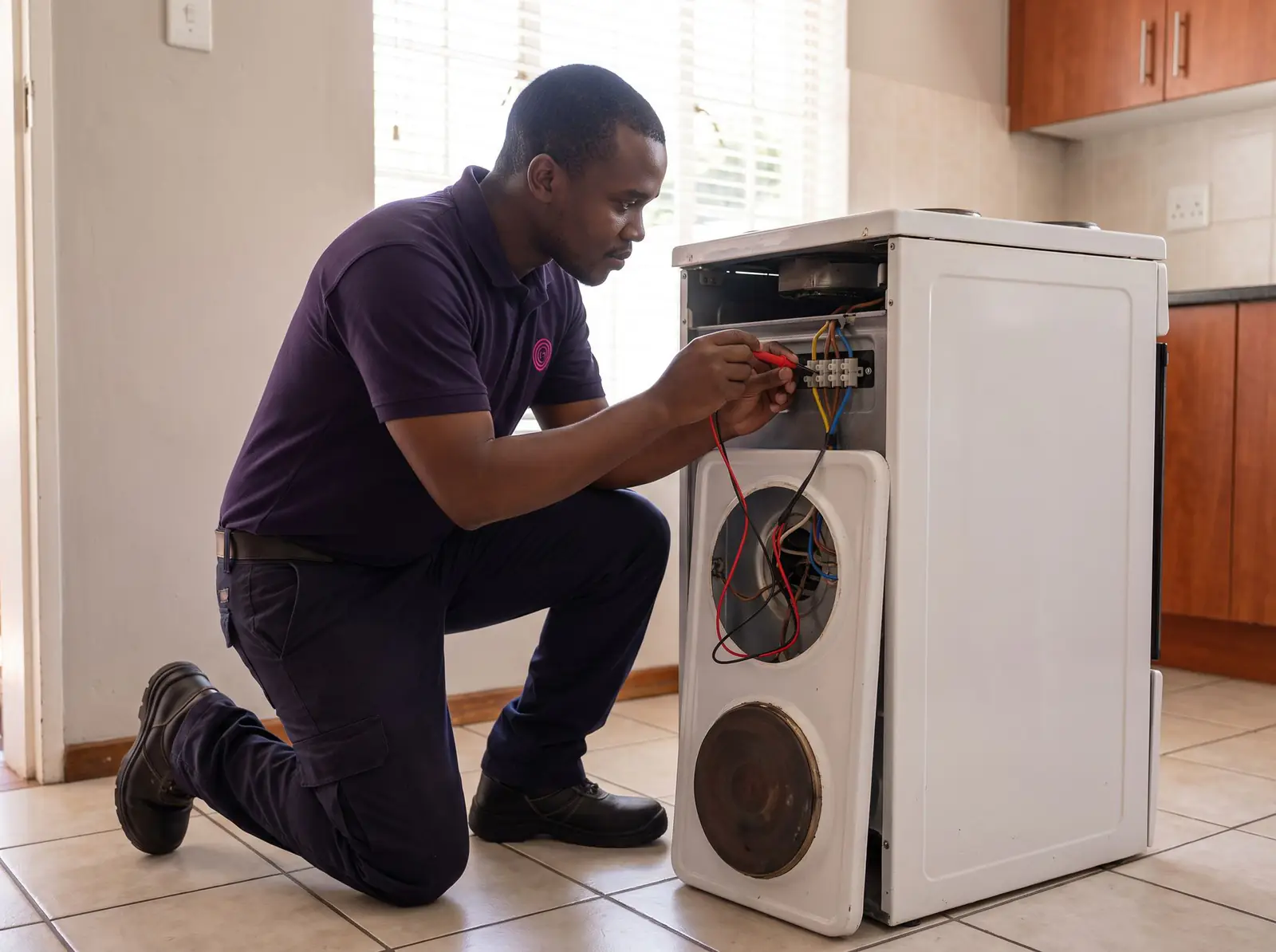
In a lot of newer Randburg kitchens, from Northriding to Randpark Ridge, the stove is a flat glass-ceramic hob with a built-in or under-counter oven below. Under the smooth glass are radiant elements, one for each cooking zone, each controlled by its own switch. When a zone stops heating, it's usually one element or one switch, and both can be replaced without replacing the whole hob.
Ovens have their own common complaint: they heat, but not properly. The cake that used to take forty minutes now takes an hour, or the roast burns on top while staying pale underneath. That's usually the thermostat, a fan element or the door seal, and it can be tested and fixed.
The technician comes to you, tests the hob and the oven where they stand, and tells you what's wrong and what the repair will cost before any work starts. For an oven that won't heat at all, see our safe checks first.
Suburbs we cover in Randburg
Glass-ceramic hobs and built-in ovens in Northriding and Randpark Ridge townhouses, and freestanding stoves in the homes around Ferndale and Bordeaux. We cover:
- Ferndale
- Blairgowrie
- Northriding
- Randpark Ridge
- Fontainebleau
- Robindale
- Bordeaux
- Windsor
Stove or oven faults we fix in Randburg
One hob zone not heating
The radiant element under that zone has failed, or the switch that controls it has. The glass top lifts off for the technician to replace the faulty part.
Zone stuck on full
A failed switch (an energy regulator) sends full power whatever the knob says. Switch off at the isolator until it's replaced.
Residual heat light stays on
The warning light that says a zone is hot should go out as it cools. If it stays on, the light's sensor or switch has failed. It's minor, but worth fixing.
Oven slow to cook
A thermostat reading low, a fan element that has failed, or a door seal letting heat out. An oven thermometer on the middle shelf shows how far out it is.
Burnt on top, raw underneath
On a conventional oven, the bottom element has failed while the top still works. On a fan oven, the fan element or the fan motor is the likely cause.
Oven trips the power
An element breaking down to earth, usually when it heats up. Leave the oven off at the isolator until it's checked.
Cracked glass hob
A crack in the glass is a safety issue: spills can reach the elements below. Switch off at the isolator and don't use the hob until it's been looked at.
Glass-ceramic hobs
A glass-ceramic hob is easy to clean and quick to repair when a single zone fails. To keep it in good shape, use flat-bottomed pots that match the size of the zone, lift pots rather than sliding them, and clean spills, especially sugary ones, once the glass has cooled. Sugar can pit the glass if it burns on.
Never stand on the hob or put heavy objects on it, and don't use it as a chopping board. If you see a crack, switch the hob off at the isolator.
When the oven won't hold its temperature
Put an oven thermometer on the middle shelf, set the oven to 180 °C and wait twenty minutes. If the thermometer reads far below or above the setting, the thermostat or temperature sensor is probably at fault. If it reads right but food still cooks unevenly, the fan, the fan element or the door seal is more likely.
Write down what you find and tell us when you book. It helps the technician arrive with the right idea of where to start.
Is it worth repairing?
Almost always, for the common faults. A hob element, a switch, an oven element, a thermostat, a fan motor or a door seal costs a fraction of a new hob or oven, and a built-in oven saves you the trouble of finding a model that fits the same space. Replacing starts to make sense when an old oven needs a control board and several other parts at once. The technician gives you the price first, and our repair or replace check helps you decide.
After you book
In a complex, give us the complex name, unit number and gate process when you book. Typically at your door within 60 minutes for same-day bookings. Track your technician live: when they leave, you get a live tracking link on your phone.
The technician tests the hob and the oven, explains the fault and gives you the price before any work starts.

No call-out fee when we repair it.If no repair is done, a R500 call-out applies. The technician finds the fault and explains the repair before any work starts, so you decide whether to go ahead.
Book a repairStove & oven repairs in Randburg: your questions
Can one zone on a glass hob be repaired?
Yes. Each zone has its own element and switch. The technician replaces the faulty one without replacing the whole hob.
Why does my oven take so long to cook?
Usually the thermostat reads wrong, the fan element has failed, or the door seal is letting heat out. An oven thermometer test shows which is more likely.
Is a cracked glass hob dangerous?
It can be. Spills can reach the live elements through the crack. Switch it off at the isolator and don't use it until it's been checked.
Can I use the other zones if one isn't working?
Usually, yes, if the faulty zone is just cold. If a zone is stuck on full, the glass is cracked, or the hob trips the power, switch it off at the isolator until it's repaired.
Can I use a scraper on my glass hob?
Yes, a proper hob scraper held flat removes burnt-on food safely. Don't use scourers, steel wool or abrasive cleaners, which scratch the glass.
What does a stove or oven repair cost in Randburg?
A hob element, a switch or an oven door seal is a modest repair. A thermostat or a fan element costs a little more. A cracked glass top is the expensive one. The technician prices the repair before any work starts.